
I often see teams blur the lines between customer success manager vs customer support. The difference between customer success an customer support is that customer success is a proactive, strategic function designed to drive adoption, retention, and expansion by aligning your product’s value with customer outcomes. On the other hand, customer support is a reactive service function focused on quick issue resolution and maintaining satisfaction on a day-to-day basis.
In this article, you’ll also learn which metrics best reflect each team’s impact, when it’s time to hire a CSM or a support specialist, and how outsourcing can help you scale both functions efficiently. By the end, you’ll have a clear roadmap to optimize these roles and turbocharge your customer experience.
6 Key Differences of Customer Success Manager vs Customer Support
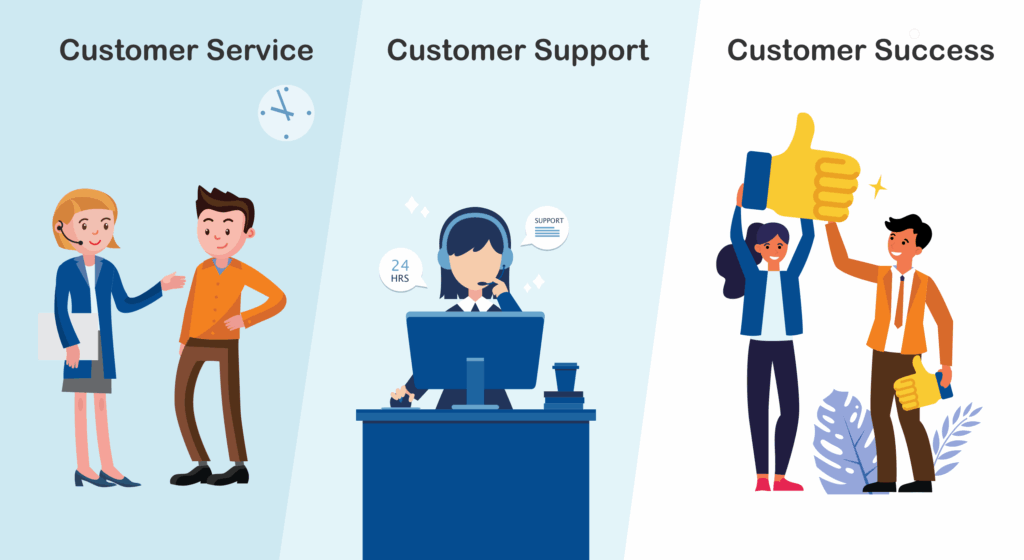
Customer Success Manager vs Customer Support #1: Proactive Engagement and Reactive Issue Resolution
Customer Success Managers focus on proactive engagement by monitoring usage trends, health scores, and customer sentiment before problems become urgent. According to the 2023 State of Customer Success report by Gainsight, companies that adopt proactive outreach see a 41% improvement in retention rates and a 32% reduction in churn.
In contrast, customer support teams measure success by how quickly they respond once a ticket is opened. Zendesk data shows 65% of customers expect a first response within an hour, and 73% will consider switching providers after a single poor support interaction. Proactive engagement reduces ticket volume and builds predictable account growth.
I usually advise my clients to set up rule-based triggers tied to key metrics such as login frequency, feature adoption, and Net Promoter Score. A simple rule might flag accounts that drop below 60% feature utilization over a 30-day window and automatically schedule a value-realization workshop. This shifts teams out of firefighting mode and into regular cadence calls that uncover expansion opportunities before churn risks escalate.
Customer Success Manager vs Customer Support #2: Strategic Growth Planning and Daily Support Tasks
Customer success managers invest roughly 35% of their time in strategic growth planning, according to TSIA research. By analyzing account health, mapping cross-sell paths, and facilitating quarterly business reviews, CSMs can boost account expansion by up to 32%. Meanwhile, Customer Support teams handle high volumes of routine inquiries or basic configuration issues that are resolved in under six minutes each. Their focus is on efficiency and first-contact resolution.
I recommend segmenting routine issues into a self-service knowledge base and AI-powered chat flows that deflect up to 40% of incoming tickets. This frees support agents to focus on complex problems and allows CSMs to dedicate more bandwidth to growth sprints.
Customer Success Manager vs Customer Support #3: Customer Feedback Fueling Product Roadmaps and Prompt Ticket Handling
Productboard’s 2023 survey reports that 63% of product managers rely on customer feedback as their primary roadmap input. Customer success managers capture high-level insights through executive interviews, advisory councils, and NPS surveys. They then translate these inputs into prioritized feature requests.
On the other hand, support teams log urgent bug reports and usability complaints in real time. Zendesk estimates 80% of frontline product feedback passes through support channels but only 40% of those tickets make it into the official product backlog.
To close this gap, we tag support tickets by request type, push feature requests into a shared JIRA board, and review submissions weekly with product, success, and support leads. We apply a simple RICE scoring framework (Reach, Impact, Confidence, Effort) to ensure that every customer voice can influence the roadmap without overwhelming development capacity.
Customer Success Manager vs Customer Support #4: Building Long-Term Relationships and Delivering Quick Fixes
Bain & Company data shows that a 5% increase in customer retention can drive profits up by 25% to 95%. Customer Success Managers invest in long-term relationships through executive business reviews, customized success plans, and ongoing strategic workshops.
Meanwhile, customer support excels at transactional resolution like resolving 80% of tickets on first contact and maintaining an average CSAT of 4.2 out of 5. However, these isolated fixes do not build the broader context needed for expansion.
I usually encourage teams to map stakeholder influence networks within each account. By identifying executive sponsors, power users, and technical champions, CSMs can tailor communication cadences and deliverables that align with each persona’s goals. And support teams document these relationships in ticket notes so that every interaction reinforces the long-term roadmap rather than standing alone as a one-off engagement.
Customer Success Manager vs Customer Support#5: Focusing on Success Metrics and Monitoring Support KPIs
Top-performing Customer Success teams achieve Net Revenue Retention rates above 120%, while the industry average sits at 105%. CSMs track health scores, adoption rates, expansion revenue, and customer lifetime value to ensure customers derive ongoing value.
Customer Support teams focus on KPIs like first-contact resolution (74% industry average), average handle time (six minutes), and CSAT (4.3 out of 5). Forrester research indicates that reducing handle time by just 1% can lower support costs by 1%.
My recommendation is to build an integrated analytics layer that brings both success and support metrics into a unified dashboard. We create alert rules so that a sudden spike in support tickets alongside a dip in product usage triggers a joint war room. This shared view accelerates root-cause analysis and drives coordinated action rather than siloed firefighting or strategy sessions without real-time context.
Customer Success Manager vs Customer Support #6: Driving ROI Growth and Sustaining Customer Satisfaction
The Technology Services Industry Association finds that mature customer success programs deliver an average ROI of 2.9x within 18 months and boost renewal rates by up to 30%. Forrester reports that 72% of buyers are more likely to repurchase after an excellent support interaction, and each 0.1 increase in CSAT corresponds to a 1.5% lift in renewal probability. Customer success managers serve as growth engines by aligning product value with business outcomes, while support teams act as the satisfaction safety net.
In my practice, I embed ROI modeling into every quarterly business review, using simple return calculators that translate feature adoption into revenue impact. At the same time, I track real-time CSAT comments via text-analytics to uncover emerging trends in user experience. Balancing these two dimensions ensures that companies are both driving measurable ROI and keeping satisfaction levels high.
Which Metrics Best Indicate Success Performance Compared To Support Metrics?
The best metrics to indicate success performance compared to support metrics are:
- Net Revenue Retention (NRR) vs First Contact Resolution (FCR)
- Expansion Revenue vs Average Response Time
- Customer Health Score vs Ticket Volume
- Product Adoption Rate vs Average Handle Time (AHT)
- Time to Value (TTV) vs Service Level Agreement (SLA) Compliance
- Renewal Rate vs Customer Satisfaction Score (CSAT)
- Customer Lifetime Value (CLTV) vs Ticket Backlog
- Net Promoter Score (NPS) vs Ticket Escalation Rate
Hiring a star customer success manager can transform those success metrics into bottom-line growth. High-impact CSMs drive expansion revenue by identifying upsell opportunities, reducing churn through proactive engagement, and accelerating time to value for each customer.
For teams that need to scale customer success without the delays of a traditional hire, GetCSM provides experienced, fractional CSM leadership. By embedding proven practitioners into your organization on a flexible basis, GetCSM helps you establish playbooks, align stakeholders and deliver ROI-focused engagements from day one.
How Does Roi Growth Reflect Customer Success Impact?
Your ROI growth reflects the direct financial impact of your customer success by turning usage and adoption into measurable revenue gains and cost savings. IDC reports that organizations tracking ROI against customer outcomes see retention rates climb by 40% and average deal sizes increase by 20%. McKinsey & Company adds that top quartile customer success teams drive revenue growth rates 2.5 times faster than their peers and deliver total shareholder returns 30% above market averages. By mapping every engagement back to ROI, you prove value, secure renewals, and justify expansion budgets.
The most powerful shift comes when you move beyond usage metrics and speak the language of finance and leadership. I focus on developing lightweight ROI models that map feature adoption to dollar outcomes, such as cost avoidance from fewer support tickets or incremental revenue from cross-sells.
When you present those figures side by side with traditional KPIs, executives stop viewing customer success as a cost center and start treating it as a growth engine. That alignment is what turns incremental improvements into board-level investments.
When Is The Right Time To Hire A Customer Success Manager Or Customer Support Specialist?
You should consider hiring a Customer Support Specialist when day-to-day service demands start to outstrip your team’s capacity. Common triggers include:
- Average weekly ticket volume exceeds 40 per agent, driving up response times beyond one hour
- CSAT dips below 4.2 out of 5 or SLA compliance falls under 90%
- A rising backlog (15% month-over-month growth) signals that routine issues are slipping through the cracks
- Your product complexity or customer base grows, creating more specialized troubleshooting needs
On the other hand, it’s time to bring on a Customer Success Manager once you have:
- Between 50 and 100 active accounts (or roughly $500K to $1M in ARR) and you’re struggling to drive adoption or expansion at scale
- Churn creeping above 5% annually despite solid support metrics, indicating a need for proactive health management
- Expansion revenue potential (upsells and cross-sells) that your current team can’t pursue without sacrificing service quality
- A desire to shift from reactive firefighting to strategic growth planning, leveraging health scores, ROI models, and executive business reviews
However, the smartest hiring decisions come from aligning headcount with clear demand-versus-capacity signals. I recommend setting up a simple hiring scorecard that tracks support workload per FTE alongside success-focused KPIs like Net Revenue Retention and average expansion bookings per customer.
When your support team is chasing tickets instead of solving root causes, or when your account executives have no bandwidth for strategic QBRs, those are your green lights to hire. This data-driven approach ensures each new hire delivers immediate value rather than becoming an overhead line item.
Conclusion: How Do Outsourcing Approaches Differ For Customer Success Managers vsCustomer Support?
Outsourcing strategies for customer success managers and customer support specialists must align with each function’s core objectives. Key differences include:
Customer Success Outsourcing Approaches
- Fractional or on-demand CSM engagements that embed seasoned success leaders into your team
- Strategic road-mapping workshops, quarterly business review facilitation, and executive stakeholder alignment
- ROI modeling and value-realization frameworks that tie adoption metrics to revenue impact
- Playbook development, process standardization, and tailored training to scale customer success operations
Customer Support Outsourcing Approaches
- Multi-tier, 24/7 global service desks trained to handle high-volume ticket queues and SLA management
- AI-driven chatbots and knowledge base systems to deflect routine inquiries and reduce ticket load
- Real-time monitoring of first-response time, average handle time, ticket volume, and CSAT
- Tiered escalation workflows that route complex technical issues to in-house experts or higher-level tiers
Many business owners struggle to transform their customer success teams into powerful revenue drivers. According to Gartner, 56% of customer success organizations lack formal revenue-driven processes, and LinkedIn’s 2023 State of customer success report finds that 75% of companies cite scaling CSM capacity as a top growth barrier. Without clear methodologies, metrics, and expert guidance, teams can become reactive cost centers rather than proactive growth engines.
GetCSM offers a turnkey solution for businesses ready to elevate your customer success function. Our team of former enterprise CSM leaders delivers playbook development, process standardization, platform integration, and team training under a flexible subscription model. By embedding dedicated CSM talent into your organization, GetCSM accelerates time to value, boosts retention and expansion rates, and transforms your customer success function into a strategic growth engine.
Book a consultation today and in 30 minutes we’ll assess your needs, pinpoint gaps, and recommend the right mix of CSM and support outsourcing for your team.