In an era where every interaction shapes customer perception and loyalty, businesses must lead the way in delivering seamless outcomes and measurable value. Customer success trends in 2025 represent the next frontier in competitive differentiation. Rising expectations and an increasingly crowded market demand a shift from reactive service to strategic partnership, where success is measured by impact rather than ticket volume.
After decades of working in this industry and with one of the big brands like Amazon, I know how crucial it is to be ahead of the curve. In this article I will break down ten customer success trends in 2025 and equip you with actionable insights to help you get ahead of the curve.
These frameworks and tactics are drawn from real-world implementations and industry benchmarks so you can assess your current capabilities, identify quick wins, and build a sustainable customer success engine.
10 Top Customer Success Trends in 2025 You Need to Know
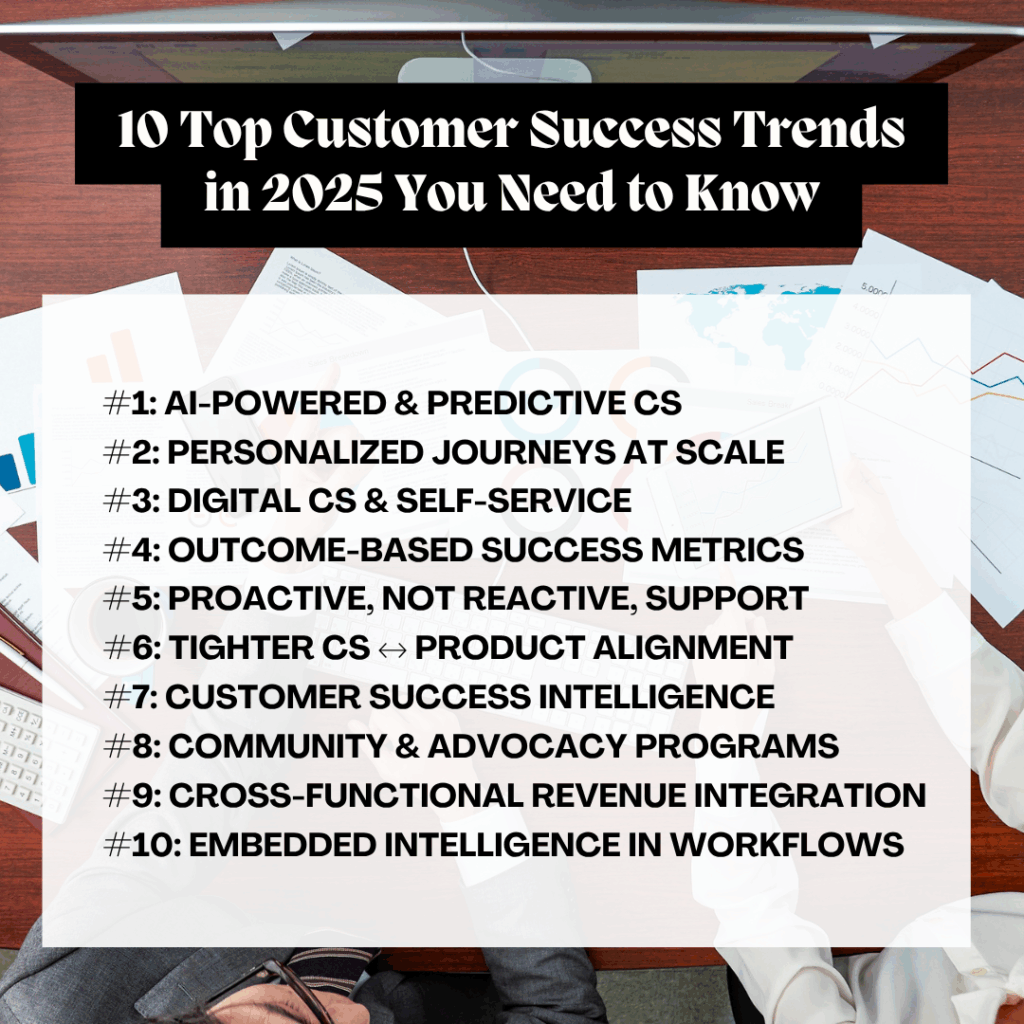
Customer Success Trends in 2025 #1: AI-Powered & Predictive CS
AI-Powered & Predictive Customer Success harnesses machine learning algorithms to forecast customer behavior and potential churn. As a business owner, you can use these insights to allocate support resources efficiently and pre-empt issues, boosting retention and revenue. According to Gartner 2024, by 2025, 65% of high-performing CS teams will adopt predictive analytics frameworks.
These tools analyze usage patterns, sentiment data, and health scores in real time, alerting you when accounts need attention. Machine learning models continuously refine predictions as they ingest new data, making your CS operations smarter over time.
In my experience, iterative model training improves forecast precision by up to 30% within three months. You can work with specialized outsourcing partners to integrate AI tools into your existing CS platform without heavy lifting on your end. This proactive focus ensures you stay one step ahead of customer issues.
Customer Success Trends in 2025 #2: Personalized Journeys at Scale

Personalized Journeys at Scale involves using customer data and automation to deliver tailored experiences to each user. Business owners benefit by increasing engagement and conversion rates through relevant touchpoints that resonate with individual customer needs.
Forrester reports that companies using personalization see a 15% lift in revenue on average. By segmenting customers based on behavior, firmographics, and preferences, you can automate customized email campaigns, product recommendations, and onboarding sequences. Advances in AI and CRM integrations enable these personalized workflows to run without manual intervention.
You can navigate this trend by mapping your customer lifecycle stages and identifying key moments for tailored interactions. Invest in a customer data platform that consolidates behavioral and transactional data for real-time segmentation. Train your CS and marketing teams on dynamic content creation and leverage API-driven workflows to automate personalized messaging. By establishing a test-and-learn culture, you ensure your personalization efforts scale effectively.
Customer Success Trends in 2025 #3: Digital CS & Self-Service
Digital Customer Success and Self-Service refer to empowering customers to find answers and solve problems independently through portals, knowledge bases, and chatbots. This trend allows business owners to reduce support costs while offering 24/7 assistance, enhancing customer satisfaction. According to Gartner 2024, 70% of customers expect self-service options for simple support tasks.
Modern self-service platforms include AI-driven knowledge suggestions, video tutorials, and interactive guides that adapt based on user queries. They also track usage metrics to identify knowledge gaps and prioritize content updates.
To adopt digital CS and self-service effectively, start by auditing your current support tickets to identify the most common queries. I recommend creating a cross-functional team to develop a centralized knowledge base with clear categories and search optimization. In my experience, enriching articles with screenshots and video snippets can cut support ticket volume by 40% within six months.
You should also integrate chatbot modules to answer routine questions and route complex issues to your CS team. By continuously analyzing user feedback and search logs, you ensure your self-service ecosystem remains relevant and powerful.
Customer Success Trends in 2025 #4: Outcome-Based Success Metrics
Automated workflows in customer success use AI to trigger routine actions like check-in emails, health assessments, and task assignments based on predefined customer events. Platforms with built-in automation report up to a 30% reduction in manual workload and faster time-to-value for key initiatives. Business owners see both cost savings and higher consistency in customer engagement.
Start by auditing your most time-consuming manual processes and prioritize those with clear event triggers. Use workflow engines in your customer success platform to set up simple “if-then” automations, such as sending renewal reminders 90 days before contract end. Always measure time saved and reinvest capacity into high-impact relationship building.
Customer Success Trends in 2025 #5: Proactive, Not Reactive, Support
Proactive, Not Reactive Support involves anticipating customer needs and addressing issues before they escalate, rather than waiting for tickets to arrive. Business owners reap the benefits of reduced churn and improved customer satisfaction through timely interventions.
Forrester 2023 found that proactive outreach reduces support costs by up to 20%. Tools for this trend include health-score monitoring, usage thresholds, and anomaly alerts that notify CS teams when customers deviate from expected patterns. Proactive support also strengthens the customer relationship by demonstrating attentiveness and foresight.
I advise leveraging AI algorithms that can detect unusual behavior patterns before they trigger dissatisfaction. From my perspective, establishing regular outreach cadences based on these alerts builds trust and prevents issues from snowballing. You can partner with an outsourcing provider to manage these notification workflows and free your internal team for higher-value tasks. Embracing proactive support signals to your customers that you are invested in their success.
Customer Success Trends in 2025 #6: Tighter CS ↔ Product Alignment
Tighter Customer Success and Product Alignment means coordinating CS feedback loops with product development to drive feature enhancements. This alignment empowers business owners to improve product-market fit and accelerate innovation cycles based on real customer insights.
According to IDC 2024, companies that integrate CS feedback into product roadmaps experience a 30 percent faster release cadence. Techniques include joint quarterly business reviews, CS-led beta programs, and shared OKRs between teams. This collaboration ensures that customer pain points translate directly into prioritized development efforts.
To tighten CS and product alignment, establish a formal process for escalating customer feedback from CS to your product team. Encourage product managers to join customer calls or business reviews to gain first-hand insights. By institutionalizing this feedback loop, you ensure your product roadmap reflects genuine customer needs and drives adoption.
Customer Success Trends in 2025 #7: Customer Success Intelligence
Customer Success Intelligence combines data analytics, AI insights, and visualization tools to give business owners a 360-degree view of customer health and engagement. This trend allows you to identify at-risk accounts, growth opportunities, and product adoption gaps with precision. Harvard Business Review 2023 notes that organisations adopting advanced CS intelligence tools improve upsell rates by 18%.
To build robust CS intelligence, start by consolidating disparate data sources into a single customer data warehouse. I find that leveraging BI platforms with AI-driven recommendations accelerates insight generation.
Training your CS team to interpret predictive dashboards is as important as the technology itself. You can outsource the initial data engineering to specialists and focus internal resources on strategic interpretation. With a strong CS intelligence framework, you turn raw data into actionable customer success plans.
Customer Success Trends in 2025 #8: Community & Advocacy Programs
Community and advocacy programs focus on building customer communities and enlisting advocates to drive referrals and reduce support load. Business owners benefit by harnessing peer-to-peer support and leveraging positive customer experiences for marketing. According to Influitive 2024, companies with active advocacy programs see referral-generated revenue grow by 22%.
To launch a community and advocacy program, start by identifying your most engaged customers and inviting them to pilot a private forum. Provide educational resources and exclusive events to maintain high engagement and foster loyalty. By cultivating a thriving customer community, you create an ever-expanding network of advocates who actively promote your brand.
Customer Success Trends in 2025 #9: Cross-Functional Revenue Integration
Cross-Functional Revenue Integration aligns sales, marketing, and customer success teams around shared revenue goals and customer lifecycles. For business owners, this trend dissolves silos and creates seamless experiences that maximise lifetime value. Deloitte 2024 reports that companies with integrated revenue operations achieve up to 15% higher growth rates.
I’ve seen organisations boost ARPU by realigning incentives and creating a single revenue operations leader. In my experience, monthly syncs between CS, marketing, and sales uncover opportunities that would otherwise go unnoticed. You can outsource revenue operations support to get expert guidance on process design and tool configuration. Embracing integrated revenue ops ensures that your customer success efforts are tightly connected to growth objectives.
Customer Success Trends in 2025 #10: Embedded Intelligence in Workflows
Embedded Intelligence in Workflows means incorporating AI and automation directly into CS tools and processes, reducing manual tasks and speeding decision-making. Business owners gain efficiency and consistency, allowing CS teams to focus on high-value strategic interactions. Organizations embedding AI assistants in workflows reduce manual hours by 30%. Examples include in-app AI suggestions for next-best actions, automated ticket routing, and real time customer sentiment alerts.
You can adopt embedded intelligence by evaluating your CS tech stack for AI-ready platforms and automations. Ensure your team receives training on how to trust and validate AI recommendations to prevent overreliance. Collaborate with your technology partner or outsourced teams to configure AI modules and integrate them into your existing workflows.
What Can Businesses Learn From Emerging Customer Success Trends?
Businesses can learn to turn customer success into a proactive growth lever by adopting AI-driven analytics, personalized automation, and integrated revenue operations. Gartner predicts that by 2025, 65% of high-performing CS teams will deploy predictive analytics to forecast customer churn before it happens. Embracing AI-powered self-service and outcome-based metrics empowers your team to focus on strategic initiatives, while aligning CS feedback with product and sales breaks down silos and accelerates innovation.
On GetCSM, I help forward-thinking business owners put these trends into practice. I guide teams to pilot churn-prediction models, design personalized journey workflows, and deploy self-service portals that cut ticket volume by 40 percent. I lead workshops to define outcome-based KPIs and establish proactive support processes that reduce costs by up to 20 percent.
We set up direct feedback loops between CS and product to align your roadmap with real customer needs and accelerate release cycles. This data-driven approach positions your CS team to drive your next phase of growth.
Conclusion: How Can Businesses Prepare For Upcoming Customer Success Trends?
Businesses can prepare by strengthening their data infrastructure, aligning cross-functional teams around customer outcomes, and piloting AI-driven CS tools to drive proactive engagement. Gartner predicts that by 2025, 65 percent of high-performing CS teams will deploy predictive analytics and automation to cut churn by up to 30 percent.
Begin with a data audit to identify your core health indicators and centralize customer information in a unified platform. Simultaneously, set shared OKRs for CS, product, and revenue operations to ensure every team is accountable for delivering customer value.
I recommend partnering with specialized CS outsourcing providers or using platforms like GetCSM to accelerate integration and leverage proven playbooks. Train your teams on data interpretation and establish regular feedback loops so you can iterate on metrics and workflows each quarter.
By adopting an agile, data-driven mindset and fostering cross-team collaboration, you’ll not only stay ahead of emerging trends but also transform customer success into your most powerful growth engine.
Book your free strategy session to learn how to leverage emerging customer success trends for sustainable growth.